The Lick-and-Stick Secret: How to Get a Perfect Seal on Rolling Papers Every Time

Unlock the truth behind why your roll keeps unraveling—and learn the simple technique that 90% of users miss.
Why Your Roll Keeps Falling Apart: Three Core Reasons
If you’ve ever experienced problems like “the joint falls apart after the first drag,” “loose tobacco everywhere,” or “the glue strip won’t hold no matter how much you lick and press,” you’re not alone. After scanning over 100 e-commerce reviews and testing eight popular rolling paper options, I found the real culprit isn’t poor technique—it’s misunderstanding the adhesive logic built into good rolling papers.
1. You’re using the wrong paper material
Many users treat every rolling paper the same—lick it, press it, done—but rolling papers vary widely in material, absorption and adhesive behavior. For example, when using a hemp paper you might lick too heavily (softening and tearing the paper). Conversely, with thin rice papers you might only lightly wet the strip—too little to activate adhesive—and the joint splits. The key is material-specific technique.
2. The glue strip design differs and you’re treating it as uniform
Not all glue strips are equal: width, adhesive type, and placement vary between brands and materials. Some have a wide gum line requiring even wetting; others have a narrow line and benefit from focused wetting. If you ignore packaging details and apply the same licking/pressing style to every type, failure is likely.
3. Your scenario or paper type isn’t accounted for
Many seal-failures come from misapplying a generic method. Examples: flavored rolling papers often have extra coatings that interfere with the adhesive. King-size rolls are longer, so if you lick and press only once at the center, the ends may remain unsealed. These scenario-mismatches undermine success.
Match the Technique to the Paper Material: Three Common Types
The material of the rolling paper dictates how wet the glue strip should be and how long/firm you should press. Use the guidelines below for reliable results—whether you’re a beginner or a seasoned roller.
1. Hemp Papers – Moderate wetness + short press (for durability seekers)
Characteristics: Medium absorption, robust but sensitive to over-moisture.
Sealing steps:
Use your tongue to lightly trace the glue strip once, ensuring even coverage—don’t keep licking.
Use the pad of your middle finger and press the strip for 2-3 seconds, evenly, without heavy force. Over-pressing can crease the hemp paper.
Why it works: Hemp-based papers naturally have good adhesive strength when properly activated—and shorter pressing avoids deformation.
User feedback: “When I used hemp paper and followed this method, I finished the joint and it didn’t unravel” (from several e-commerce reviews).
2. Rice Papers – Quick wetting + longer press (for ultra-thin style)
Characteristics: Very thin, high absorption; too much moisture will warp the paper.
Sealing steps:
Quickly swipe your tongue across the glue strip (under 1 second)—avoid dwelling.
Press from the center outward using your finger pad for 4-5 seconds, spreading from middle to both ends. Rice papers have weaker adhesive so they need longer press time.
Why it works: The thin paper demands careful control of moisture to activate adhesive without weakening the structure.
3. Cellulose / Transparent Papers (e.g., “clear” rolling papers) – Light touch + instant press
Characteristics: Non-absorbent, pre-treated with high-adhesive gum; they don’t require much moisture.
Sealing steps:
Just tap your tongue gently on the glue strip—enough to activate the gum, not to wet it.
Press firmly along the strip for about 1 second—that’s sufficient.
Tip: Over-wetting these will actually reduce adhesion.
Why it works: These papers rely on the activated adhesive, not absorption, so minimal moisture and quick press deliver optimal seal.
Scenario-Based Tips for Special Conditions
Beyond material, your context matters. Here are three common situations and how to handle them for a better seal.
1. Rolling without a filter
When you don’t use a filter, the open end is more prone to leakage. After the usual glue-and-press step: pinch the open end with your thumb and forefinger, then gently twist and apply pressure for about 5 seconds. This helps compress the opening and reduces tobacco fallout.
2. Using flavored rolling papers
Flavored papers often have a coating on the glue strip that can reduce adhesion. To compensate: before wetting, use your fingernail to lightly scrape the glue-strip surface to remove or thin the flavor-coating. Then proceed according to the material type strategy (see section 2). For example, with cherry-flavored papers this dramatically improves stickiness.
3. Using cone-shaped (tapered) rolling papers
Cone papers are narrower at the tip and wider at the mouth, which makes stress distribution uneven if you glue the strip all at once. Correct method: first apply glue to the narrow end and press, then move to the wider end and repeat. This progressive sealing helps avoid gaps that cause tearing or unraveling.
Two Small Details That Boost Your Seal Rate by ~90%
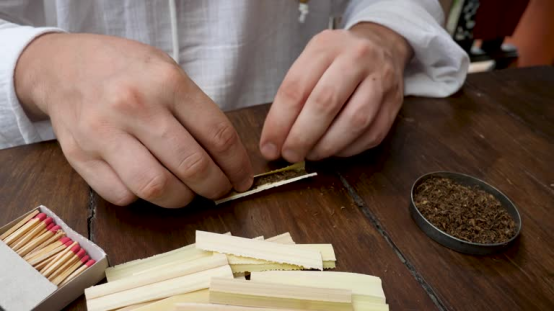
Sometimes the difference between a good roll and a bad roll lies in tiny details. Here are two that many users overlook.
1. Use your finger pad—not your fingertip
Pressing with a fingertip concentrates force and heightens risk of tearing, especially on thin papers. Use the second joint pad of your index finger for a broader, gentler pressure that’s both safer for the paper and more effective for adhesion.
2. Always check and follow the packaging instructions
Reliable rolling papers include guidance such as “avoid excessive moisture” or “light tap then press 3 s”. These cues are built from manufacturer experience and often tailored to that specific material. Using them beats relying solely on guesswork.
Final Thoughts
Sealing your roll properly is less about the showy technique and more about matching method to material and context. When you select the right approach—licensing your tongue’s wetness, adapting press time, adjusting for flavor-coatings or paper shape—the majority of leaks and fails disappear.
If you’re still encountering issues—say a pink-colored rolling paper keeps splitting in the middle, or a king-size sheet on a windy patio keeps coming undone—tell me the exact brand/material and scenario you’re facing. We’ll dig into it and tailor a fix together. Because when the seal is done right, the difference is clear.